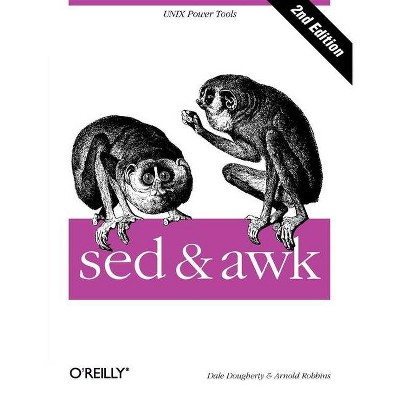
Sed & awk - (Nutshell Handbooks) 2nd Edition by Dale Dougherty & Arnold Robbins (Paperback)
Similar Products

Products of same category from the store
All




Product info
<p/><br></br><p><b> About the Book </b></p></br></br>This edition describes two text processing programs that are mainstays of the UNIX programmer's toolbox. The book lays a foundation for both programs by describing how they are used and by introducing the fundamental concepts of regular expressions and text matching. Cover Title<p/><br></br><p><b> Book Synopsis </b></p></br></br><p><i>sed & awk</i> describes two text processing programs that are mainstays of the UNIX programmer's toolbox.<i>sed</i> is a stream editor for editing streams of text that might be too large to edit as a single file, or that might be generated on the fly as part of a larger data processing step. The most common operation done with <i>sed</i> is substitution, replacing one block of text with another.<i>awk</i> is a complete programming language. Unlike many conventional languages, <i>awk</i> is data driven -- you specify what kind of data you are interested in and the operations to be performed when that data is found. <i>awk</i> does many things for you, including automatically opening and closing data files, reading records, breaking the records up into fields, and counting the records. While <i>awk</i> provides the features of most conventional programming languages, it also includes some unconventional features, such as extended regular expression matching and associative arrays. <i>sed & awk</i> describes both programs in detail and includes a chapter of example <i>sed</i> and <i>awk</i> scripts.This edition covers features of <i>sed</i> and <i>awk</i> that are mandated by the POSIX standard. This most notably affects <i>awk</i>, where POSIX standardized a new variable, CONVFMT, and new functions, <i>toupper</i>() and <i>tolower</i>(). The CONVFMT variable specifies the conversion format to use when converting numbers to strings (<i>awk</i> used to use OFMT for this purpose). The <i>toupper</i>() and <i>tolower</i>() functions each take a (presumably mixed case) string argument and return a new version of the string with all letters translated to the corresponding case.In addition, this edition covers GNU <i>sed</i>, newly available since the first edition. It also updates the first edition coverage of Bell Labs <i>nawk</i> and GNU <i>awk</i> (<i>gawk</i>), covers <i>mawk</i>, an additional freely available implementation of <i>awk</i>, and briefly discusses three commercial versions of <i>awk</i>, MKS <i>awk</i>, Thompson Automation <i>awk</i> (<i>tawk</i>), and Videosoft (VSAwk).</p><p/><br></br><p><b> From the Back Cover </b></p></br></br>The book begins with an overview and a tutorial that demonstrate a progression in functionality from grep to sed to awk. sed and awk share a similar command-line syntax, accepting user instructions in the form of a script. Because all three programs use UNIX regular expressions, an entire chapter is devoted to understanding UNIX regular expression syntax. Next, the book describes how to write sed scripts. After getting started by writing a few simple scripts, you'll learn other basic commands that parallel manual editing actions, as well as advanced commands that introduce simple programming constructs. Among the advanced commands are those that manipulate the hold space, a set-aside temporary buffer. The second part of the book has been extensively revised to include POSIX awk as well as coverage of three freely available and three commercial versions of awk. The book introduces the primary features of the awk language and how to write simple scripts. You'll also learn: common programming constructs; how to use awk's built-in functions; how to write user-defined functions; debugging techniques for awk programs; how to develop an application that processes an index, demonstrating much of the power of awk; and FTP and contact information for obtaining various versions of awk. Also included is a miscellany of user-contributed scripts that demonstrate a wide range of sed and awk scripting styles and techniques.<p/><br></br><p><b> About the Author </b></p></br></br><p>Dale Dougherty is the publisher of the O'Reilly Network and Director of O'Reilly Research. Dale has been instrumental in many of O'Reilly's most important efforts, including founding O'Reilly & Associates with Tim O'Reilly. He was the developer and publisher of Global Network Navigator (GNN), the first commercial Web site. Dale was developer and publisher of Web Review, the online magazine for Web designers, and he was O'Reilly & Associates' first editor. Dale has written and edited numerous books at O'Reilly & Associates. Dougherty is a Lecturer in the School of Information Management and Systems (SIMS) at the University of California at Berkeley.</p><p>Arnold Robbins, an Atlanta native, is a professional programmer and technical author. He has worked with Unix systems since 1980, when he was introduced to a PDP-11 running a version of Sixth Edition Unix. He has been a heavy AWK user since 1987, when he became involved with gawk, the GNU project's version of AWK. As a member of the POSIX 1003.2 balloting group, he helped shape the POSIX standard for AWK. He is currently the maintainer of gawk and its documentation. He is also coauthor of the sixth edition of O'Reilly's Learning the vi Editor. Since late 1997, he and his family have been living happily in Israel.</p>
Price History
Cheapest price in the interval: 28.99 on October 23, 2021
Most expensive price in the interval: 28.99 on November 8, 2021
Price Archive shows prices from various stores, lets you see history and find the cheapest. There is no actual sale on the website. For all support, inquiry and suggestion messages communication@pricearchive.us